

The Father of Arizona
Charles D. Poston
Pioneer. Statesman. Visionary. The man who created Arizona — and dreamed of a solar pyramid temple in its desert.
Arizona's Forgotten Founder
If you ask most Americans who founded Arizona, you'll be met with a blank stare. Yet without one man's relentless lobbying in the halls of Congress, Arizona might never have become a territory — let alone a state.
Charles Debrille Poston was a Kentucky-born adventurer who fell in love with the Sonoran Desert and devoted decades of his life to shaping its destiny. He was a miner, a diplomat, a politician, a writer, a mystic, and a dreamer — often all at once.
He was also a man who, in the twilight of his life, stood on a desert hilltop and imagined a pyramid rising toward the sun — a temple where the ancient light of Zoroaster would illuminate the land he had given his life to build.
He died before he could build it. We intend to finish what he started.
This is an article that first appeared in 2012, in the "Sun-Runner Journal" of the So. Calif. High Desert
Charles Debrille Poston: "The Father (and First 'New Age Seer') of Arizona!" by Steven "Sunny" Sun-Downer In this, the year ending the "Mayan Calendar," 2012, one of the northern neighbors of the country (Mexico) that hosts the Mayan Tribe, Arizona (the last state of the contiguous United States to enter the Union as number 48) celebrates its Centennial after 100 years of State-hood that began February 14, 1912. Most people who travel to Arizona on Southern California's Interstate 10 may stop to fuel up at that first exit east of Blythe, (usually saving a LOT of money per gallon off California fuel prices!) called "Ehrenberg Exit" named for the town to the north on the Colorado River. The road of the exit itself, just after the proud Arizona State Flag-bedecked "Arizona Centennial- 1912 to 2012" signs, some may notice, is called "Poston Road." One may wonder, who were these men that this Arizona town and road are named after? The first answer, easily found these days on the internet, is that Poston Road is named for Charles Debrille Poston, who lived from 1825 to 1902. He was one of Arizona's first ("gringo") explorers, gold and silver miners, lawyers, judges, journalists, irrigation specialists... the list of talents of this man was almost endless, but also notably, he was not only the original claimant to the land that now comprises Phoenix's "Downtown Playground," Papago Park (site of the Hohokam Tribe's Solstice Ceremonies) but he was also Arizona's first Congressional Representative as well as Native American Bureau Superintendent, and more- all for which he has received the title "The Father of Arizona." The second man, Herman Ehrenberg, was a mining engineer who Poston met about 1853 in San Francisco, where he had come from Kentucky to "seek his fortune" in the California Gold Rush (ending up as a Customs House Clerk) and Ehrenberg became his partner in a gold and silver prospecting venture to explore the lands of the recent Gadsden Purchase, financed by French bankers. One of their first particularly interesting adventures ended up inadvertently creating the town of Yuma, which they originally named "Colorado City." When the group, on the return journey to California with the mineral samples and their maps, reached the Colorado River, the only way to cross back and forth was by way of a ferry. Since the ferry operated in hostile Native American territory, the cost of crossing was quite high. Poston refused to pay the extreme toll. Instead, he came up with the idea of creating city lots to pay for their passage. One of the explorers was a skilled surveyor, so he laid out the streets grids, town square, docks and piers. When the ferryman's curiosity finally stirred him to ask what was going on, Poston told him, "Oh, haven't you heard? We're here to create a new city, a magnificent center for trading and commerce, to be called 'Colorado City!' If you're smart you'll buy in ahead of the others!" The ferry operator was impressed enough to buy the first few plots, enabling Poston and his team to pay their passage across the river. It was at this time that Poston met the commanding officer of Fort Yuma, Major Heintzelman. After returning to San Francisco, Poston left for the East Coast in search of capital to fund a mining operation in the newly acquired territory. After several unsuccessful attempts, he was introduced to several Cincinnati, Ohio investors by Heintzelman. On March 24, 1856, $2 million (approximately $400 million today) was secured to found the Sonora Exploring and Mining Company with Heintzelman as company President and "Colonel" (as he came to be called) Poston as "Managing Supervisor." The Texas and Pacific Railroad Company contributed a grant of $100,000. The expedition of around 350 men left Texas in May of that year, arriving in Tuscon in August. They then headed about 38 miles south to the Presidio of Tubac, located on the Santa Cruz River. Tubac was the oldest European settlement in the territory, originally settled by the Spanish in 1752. It was more recently abandoned but left intact minus doors and windows that had been carted away by the Mexican troops. After they set up the the mining operation, word reached Sonora in the South of the employment opportunity, and before long the community had swelled to over a thousand miners including some families. They harvested pine-wood from the local Santa Rita Mountains to be milled with whip-saws for the doors, windows, tables, bedsteads, other furniture and animal corrals. Soon, the operation was realizing about $3000 a day in silver ore, and surely the investors would be quite happy. As "Alcalde," Col. Poston was the law under the rules and regulations that governed the Territory of New Mexico at the time. He had many duties, including mayor, judge, town treasurer and justice of the peace. He was legally authorized to execute criminals and declare war, but spent most of his time keeping official records, performing marriages, baptizing children, etc. This continued until Father Macheboeuf, the vicar of Bishop Jean-Baptiste Lamy, was sent from Santa Fe to investigate the goings-on in Tubac. The validity of the marriages Poston had performed was questioned by the vicar, and to prevent a "revolt" amongst those who had been married by Poston, a $700 "donation" was made before Father Macheboeuf sanctified the unions. And speaking of money, Poston also printed some of the territory's first paper money, so residents wouldn't be burdened with the weight of the silver. "Silver bullion being rather too weighty for purposes of exchange, the company adopted the Mexican system of 'boletas.' Engravings were made in New York and paper money printed on pasteboard about two inches by three, in small denominations. Each boleta had a picture by which the illiterate could ascertain its denomination: twelve and one-half cents a pig; twenty-five cents, a calf; fifty cents, a rooster; one dollar, a horse; five dollars, a bull; ten dollars, a lion. With these boletas the miners were paid off every Saturday, and they were taken as currency at the stores, and among the merchants in the country and in Mexico. When a run of silver was made, anyone holding tickets could have them redeemed in silver bars... This primitive system of flat money had an excellent effect. Everybody holding these boletas was interested in the success of the mines, and the entire community was dependent for its prosperity upon that of the company. They were all redeemed and retired from circulation."* He wrote of the Mexican women who made their way up to his community, "Sonora has always been famous for the beauty and gracefulness of its senoritas. When they could get transportation in wagons hauling provisions, they came in state; others came in on the hurricane decks of burros and many came on foot. All were provided for. They really had a refining influence on the frontier population. Many of them had been educated at convents, and all of them were good Catholics. If there is anything that a Mexican woman despises it is a red petticoat. They are exceedingly dainty in their underclothing and wear the finest linen they can afford; they spend half their lives over the washing machine... This accretion of female population added very much to the charms of frontier society. The Mexican women were not by any means useless appendages in camp. They could keep house, cook some dainty dishes, wash clothes, sew, dance and sing. Moreover, they were expert at cards and divested many a miner of his week's wages over a game of monte... An idea that it was lonesome at Tubac would be incorrect. One can never be lonesome who is useful, and it was considered at the time that the opening of mines which yielded nothing before, the cultivation of land which lay fallow, the employment of labor which was idle, and the development of a new country, were meritorious undertakings... The usual routine at Tubac, in addition to the regular business of distributing supplies to the mining camps, was chocolate or strong coffee the first thing in the morning, breakfast at sunrise, dinner at noon, and supper at sunset... In the spring of 1857 a garden containing about two acres was prepared at Tubac, and irrigated by a canal from the Santa Cruz River and we soon produced all the vegetables, melons, etc., that we required, and many a weary traveler remembers, or ought to remember, the hospitality of Tubac. We were never a week without some company and sometimes had more than we required; but nobody was ever charged anything for entertainment, horse-shoeing, and fresh supplies for the road. Hospitality is a savage virtue, and disappears with civilization."* Poston was certainly ahead of his time, when he stated, "In countries requiring irrigation, the communal system of distributing water has been found to produce the greatest good for the greatest number. The plan of a government granting water to corporations, to be sold as a monopoly, is an atrocity against nature; and no deserving people will for long submit to it. The question will soon come up whether the government has any more right to sell the water than the air."* Poston may have "over-simplified" things when he wrote in his diary of the Utopia he had created, "We had no Law but Love, and no occupation but labor. No government, no taxes, no public debt and no politics. It was a community in a perfect state of nature..."* Unfortunately, his "Utopia" had to come to an end, when, in 1861 with the advent of the Civil War, the Union troops were withdrawn from the region, and Poston and his workers barely escaped with their lives with the threat of marauding Apache Warriors and Mexican Bandits approaching. Leaving behind about $1 million in mining equipment, it took them six months on the overland route to reach San Diego, Calif. Poston then went to Washington D.C. where he worked for the new "General" Heintzelman as a civilian aide. Poston was introduced by the General to President Lincoln (who's family was friends w/Poston's in Kentucky. In fact, Poston's father, Temple- who had hired Abe's father to build their 2-story home, bought Abe and his brother their first pair of boots one winter, upon seeing them running around barefoot**). Poston used this time to lead the fight to have Arizona established as a territory separate from New Mexico. While this had been attempted several times before, it was believed that because Poston was a "Union Man" and possessed considerable powers of persuasion, he might succeed. He took to the task with his characteristic thoroughness and conviction. The President was looking for ways to finance the Union Army in the Civil War, so Poston endeavored to convince him of the value of Arizona's untapped silver, gold and copper mines. The President was so impressed he sent Poston to Congress to immediately call for a bill which would create the Arizona Territory. The bill passed quickly and Arizona became a territory officially on February 24, 1863. Poston had brought silver from the Arizona mines with him and had a $1500- inkwell fashioned at Tiffany's in New York, which he presented to Lincoln at the signing (and is now housed in the Library of Congress). Poston had worked for over twelve years to achieve Territory Status for Arizona, and while he was vindicated by the signing, he was given the rather thankless position of Superintendent of Indian Affairs, and while this did seem like a snub to his skills, it did get him back to his beloved "New" Territory. During his tenure, Poston proposed creating irrigation systems. He then became Arizona's first delegate to Congress in July of 1864, where he was able to persuade Congress to create Arizona's first Native American reservation on the Colorado River and the start of an irrigation program. He also had a dream to create a shipping canal from Yuma to the Gulf of California, for silver and other commodities. His Congressional term only lasted a few months, and because he was slandered by his competition in the then Capitol of Prescott, and was not in the Territory to defend his good name and works, he was defeated for re-electiond. After losing yet a second time, perhaps he felt dejected and that it was time to move on, as he then traveled to Europe, and wrote his book, Europe in the Summer-Time. He was then commissioned by Secretary of State Seward in 1868 to deliver the Burlingame Treaty to the Emporer of China, and to study irrigation systems there . In that modern-day Arizona has a thriving tourism industry in the "New Age Vortex Mecca" of Sedona, Poston was again ahead of his time, because he traveled further to India where he became inspired by the Sun Worship of Zoroasterianism, before heading farther west to the pyramids and waterways of Egypt. After more travel in Europe, he returned to the U.S. for the Centennial Exposition of 1876 and then returned to Arizona to take the post of Registrar of the Federal Land Office in Florence, a humble position for a man of such great vision. There he discovered the ruins of an ancient tower atop a hill, and thought that it had been created by ancestors of the Native American Hohokam or Aztecs, tribes in whose Spiritual Practices the Sun played a central role. His "Grand Vision" was to build a great pyramid Temple of the Sun on that spot. (Nowadays, the Florence Museum, near Poston's Highway Historical Marker, has an exhibit on him that claims that the local people "...considered Poston to be strange, yet visionary.") In his later life he headed toward Tuscon, where he held many different positions including lecturer, writer, mining, irrigation and railroad promoter. He seemed to take on the demeanor of a somewhat eccentric elder statesman, even taking shots at a local editor who impugned his integrity. He also championed several worthwhile enterprises, such as the formation of the Pioneer's Historical Society, his conservation efforts and his efforts to resolve the Native American situation. He gave one of his last lectures in 1899 in Phoenix, at the age of seventy-four. The lecture was titled “How I Spent Christmas.” He recounted his personal celebrations of Christmas with people like Mark Twain, Joaquin Miller, Garibaldi, and other European royalty. However, he said his best Christmas was in Tubac in 1856. For the rest of his life, he held various positions, none with the degree of previous importance, and eventually ended up living in poverty in Phoenix. Thankfully, the legislature became aware of his circumstances. In an effort to alleviate his situation and in recognition of his valuable service, the Legislature of Arizona in 1899 voted him a pension of $25 per month. This act described some of his accomplishments (most of which are featured above)- "...Whereas Charles D. Poston in January 1854, prospected the Ajo mines in what is now Pima County, Arizona, and in the same year, organized on said mines the first mining company to invest capital and to do development work on mines in what is now Arizona... and in 1863 gave Arizona her name... (mention of Territory signing and his many other accomplishments) Whereas, from the above and many other well-known facts, Charles D. Poston, among all other pioneers, was pre-eminently the moving spirit, and in fact, may be truly said to be the 'Father of Arizona.' " -U.S. Congress, 1899 Poston died in June 1902 at age 75. His body very nearly remained unclaimed until the editor of the Phoenix newspaper ran a story about him. Then hundreds of citizens offered to help with funeral costs. 23 years after his death, and on the Centennial of his birth, the citizens of Arizona decided to honor Poston. They built a small pyramid atop his beloved hill in Florence (now called "Poston Butte") and his remains were transported there — a fitting end to the life-story of the Father of Arizona." *-from "The University of Arizona Library Books of the Southwest, Chapter 17: Early Mines and Mining" ** (Personally told to the author, by his Grandmother, Mary Lee Pope, [born 1892, Ft. Whipple, Prescott AZ] Daughter of Sara Lee Poston, and Grand-daughter of Charles Debrille Poston.) (Please stay "Posted" for the non-profit being established, in which we will honor his great lifetime's work in various methods that include Historical Event Re-enactment... as well as to create Sun Temples throughout the South-West area to honor the "Father of Arizona," Charles Debrille Poston, his daughter Sara Lee Poston/Pope and his grand-daughter, Mary Lee Pope. Also, please go to Youtube and enjoy No. Arizona actor Parker Anderson's live portrayal of Poston in his own write, "Building a State in Apache Land," performed for the Arizona Centennial Celebration at Prescott, Arizona's Sharlot Hall Museum). Search for “Poston Sun Temple Foundation 2012 Tribute To Father of Arizona Charles D Poston”..! -Steven "Sunny" Sun-Downer is a 'High-Desert' Journalist who has written articles for the Desert Post Weekly, American Free Journal and the Conchus Times Journal. He can be reached at [email protected]
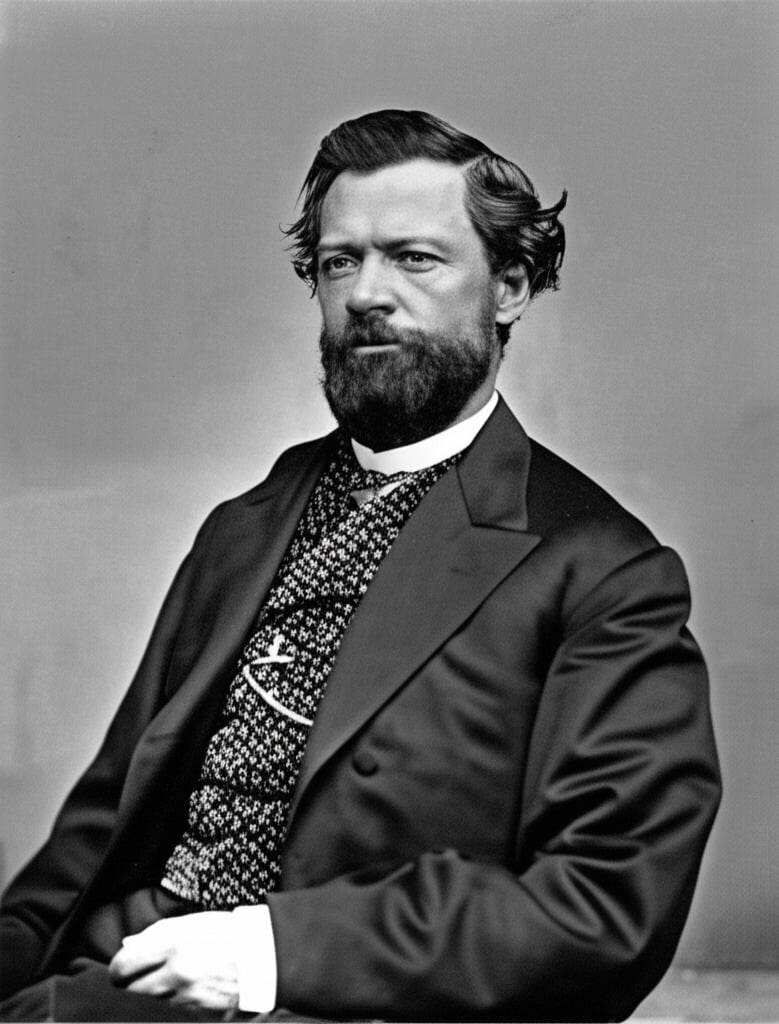
Charles D. Poston, c. 1870s
A Life in the Desert
Born in Elizabethtown, Kentucky
Charles Debrille Poston was born on April 20, 1825, in Elizabethtown, Kentucky. From an early age he displayed a restless curiosity and an appetite for adventure that would define his entire life.
Arrival in the Southwest
Poston arrived in the Southwest during the great era of American expansion. He worked as a surveyor and explorer, traveling through what would become Arizona and developing a deep, lifelong attachment to its desert landscapes and indigenous peoples.
Mining Pioneer in Arizona
Poston established the Sonora Exploring and Mining Company, operating silver mines near Tubac in the Santa Cruz Valley. He governed the mining community with remarkable autonomy — performing marriages, granting divorces, and administering justice in a land with no formal government.
Father of Arizona
Poston traveled to Washington D.C. and lobbied Congress tirelessly for Arizona's separation from New Mexico Territory. On February 24, 1863, President Lincoln signed the Arizona Organic Act into law. Poston was appointed Superintendent of Indian Affairs for the new territory — earning him the enduring title "Father of Arizona."
Arizona's First Delegate to Congress
Poston was elected as Arizona's first delegate to the United States House of Representatives, serving from 1864 to 1865. He championed the territory's interests in Washington and worked to bring settlers, infrastructure, and recognition to the young territory.
Journey to the East — Embracing Zoroastrianism
After years of political and financial setbacks, Poston embarked on a remarkable spiritual journey to Persia and India, where he encountered Zoroastrianism — the ancient faith of fire, light, and the sun. He was deeply moved by its reverence for the natural world and its solar symbolism, which resonated with his own love of the Arizona desert.
The Dream of a Sun Temple
Returning to Arizona, Poston purchased land atop Primrose Hill near the Gila River. He envisioned building a Zoroastrian sun temple there — a pyramid aligned to the rising sun where people could gather to honor light, nature, and the spirit of the desert. He even hired laborers to begin grading the hilltop, but funds ran out before construction could begin.
Poverty and Obscurity
The final decades of Poston's life were marked by poverty and neglect. The man who had done more than anyone to create Arizona Territory lived in near destitution in Phoenix, largely forgotten by the territory he had brought into existence. The Arizona Legislature eventually granted him a small pension of $25 per month.
Death and Legacy
Charles D. Poston died on June 24, 1902, in Phoenix, Arizona. He was buried on the summit of Primrose Hill (now known as Poston's Butte) near Florence, Arizona — as close to the sun as he could be. His temple was never built. His dream endures.
The Dream That Outlived Him
In his final years, Poston wrote and lectured about his vision for a Zoroastrian sun temple on Poston Butte. He called it a place where the people of Arizona could gather to honor the light that sustained all life in the desert — a monument not to any one religion, but to the universal reverence for the sun.
"The sun is the source of all life," he wrote. "In the desert, you cannot forget this. Every morning the light returns and the world is made new."
He died in 1902 with his pyramid unbuilt and his name largely forgotten. The Poston Sun Temple Project exists to honor his vision — to build the temple he imagined, in the desert he loved, as a living monument to the Father of Arizona.
Watch